From Test Site to Trailblazer: HITRANS Strategy Charts Future of Drones and Electric Flight Across the Highlands and Islands
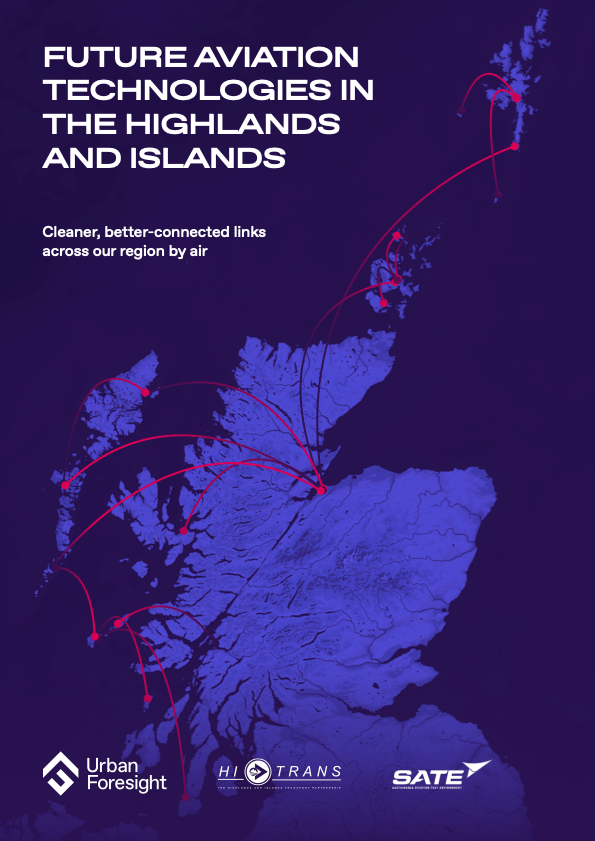
The Highlands and Islands Transport Partnership (HITRANS) has published a ten-year strategy setting out how drones, electric aircraft and other low-carbon technologies could reshape travel and freight across one of the UK’s most remote regions.
The strategy, Future Aviation Technologies in the Highlands and Islands, was developed under the Innovate UK-funded Future Flight Challenge as part of the Sustainable Aviation Test Environment (SATE) project, which HITRANS leads. It was created in partnership with Urban Foresight and the SATE consortium.

The document addresses a problem familiar to anyone living in the region: roughly half a million people spread across an area larger than Wales, many in communities reliant on ferries and long road journeys that are frequently disrupted by weather. Air travel already underpins access to hospitals, jobs and education, but the strategy argues that ageing infrastructure, staff shortages and the pressure to cut emissions mean the current network cannot simply stay as it is.
Rather than betting on a single technology, the strategy assesses six in parallel — drones, electric and hybrid fixed-wing aircraft, hydrogen aircraft, eVTOL aircraft, airships and seagliders — and matches each to the role it is best placed to play. Drones, already flying medical and mail deliveries elsewhere in the UK, are identified as the technology likely to scale fastest, particularly for NHS Scotland logistics and inter-island freight. Electric and hybrid aircraft are pitched as a near-term fit for the short routes already served by small planes across the region, while hydrogen aircraft, eVTOL and airships are framed as medium-to-long-term opportunities dependent on further certification, infrastructure and cost reductions.
Central to the strategy’s case is SATE itself, which became the UK’s first operationally based low-carbon aviation test centre when it launched at Kirkwall in 2020. The project has since delivered Scotland’s first hybrid-electric flights and trialled autonomous drone deliveries in the Orkney Islands, providing real-world evidence — on weather, airport operations and safety — that the strategy says will be essential for shaping future regulation.
“This strategy is a significant milestone for our region,” said Dawn Gillies, Sustainable Aviation Development Manager at HITRANS. “SATE has already proven that a live, working airport can test the aviation technologies of the future — and this plan sets out how we turn that early success into everyday reality. Our ambition is clear: for the Highlands and Islands to lead the UK’s transition to sustainable aviation, not just take part in it.”
The strategy also sets out how delivery would be coordinated. It proposes a new Flight Path Advisory Group, bringing together HIAL, the Civil Aviation Authority, NHS Scotland, the University of the Highlands and Islands and other regulators and operators, to guide infrastructure investment and training across all the technologies without favouring any single one.
Beyond connectivity, the strategy points to wider benefits: faster delivery of medical samples and supplies, quicker routes to market for an aquaculture and seafood sector that exports 70% of its output, and new low-carbon options for tourism. It frames these as central to a broader ambition — using the region’s geography, once seen as an obstacle, as the proving ground for technologies that could eventually be deployed across the rest of the UK.
You can read the full strategy here.